We will continuously update this page with speaker information

Prof. Shihab Al-Daffaie is a professor in Terahertz Nanophotonics and Integration Technology (TNIT) in the Integrated Circuits group at the Electrical Engineering Department of Eindhoven University of Technology. He earned his PhD in Electrical Engineering from TU Darmstadt (Germany) in 2015, where he later founded and led the Nanophotonics and Terahertz Technology (NTT) group. His research focuses on using nano-optoelectronics, -materials, and -technologies in the semiconductor integration field for extremely high-frequency devices (terahertz but not limited) addresses critical challenges in miniaturizing THz systems for applications spanning 6G communications, biomedical sensing (e.g., early virus detection), security (explosive scanning), and industrial quality control. In 2023, he was appointed Focus Area Leader for “Integrated Remote Sensing Systems” at the Eindhoven Hendrik Casimir Institute, driving innovations in remote sensing. Notably, in 2025, he launched the €2.86 million EU-funded Terahertz Integrated Biosensing Project (TeraIBs), coordinating nine universities and five industry partners to develop modular THz biosensors and organ-on-chip models for real-time disease diagnostics, emphasizing his commitment to translating research into healthcare solutions. With over 60 high-impact publications and leadership roles such as chairing the 2023 International Travelling Summer School on THz Science, he bridges academic excellence with industrial collaboration, positioning him at the forefront of THz technology’s global advancement.

Mark Bentum is a Full Professor in Radio Science with the research group Electromagnetics at the TU/e department of Electrical Engineering. He is also affiliated with the Netherlands Foundation for Research in Radio Astronomy (ASTRON), where he is head of the radio group. His main research interest is in radio astronomy, particular in low frequency radio astronomy. He is the initiator of the OLFAR project, the Orbiting Low Frequency Antennas for Radio astronomy. OLFAR is a space-based radio telescope to observe the sky at frequencies below 30 MHz consisting of many small satellites. Opening this virtually unexplored frequency band will possibly lead to new scientific insights, like the formation of the Universe and the detection of magnetized exoplanets.
At TU/e his work focuses on various aspects of this radio telescope, such as the antenna systems, the calibration of the array, the clocking and synchronization of all the elements, localization, interference mitigation and the signal processing aspects of the telescope. Mark Bentum is a senior member of the IEEE, vice chair of the IEEE Benelux section, initiator and chair of the IEEE Benelux AESS/GRSS chapter, and has acted as a reviewer for various conferences and journals.
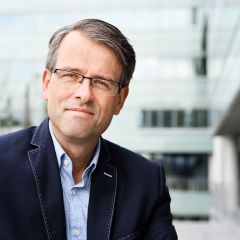
Bart Smolders received his M.Sc. and Ph.D. degree in Electrical Engineering from Eindhoven University of Technology (TU/e) in 1989 and 1994, respectively. He worked at NXP (formerly Philips) Semiconductors, responsible for the innovation in the RF business line. Since 2010, he is full-time professor at the TU/e and chairman of the Electromagnetics Group with special interest in antenna systems and applications, such as 6G wireless communications. In particular, he is co-founder of the FNS-6G national growth-fund project. He is also co-founder of the start-up company ANTENNEX.
Next to his research activities, he was the dean of the Electrical Engineering department of the TU/e in the period 2016-2023. Currently, he is responsible for the Future Chips initiative at TU/e.

Joost Kok has been Vice-Dean of Mathematics and Computer Science and a professor of Applied Data Science at Eindhoven University of Technology since May 2024. Before moving to Eindhoven University of Technology, he was employed by the University of Twente since 2018, where he was Dean of the faculty of Electrical Engineering, Mathematics and Computer Science. Previously, he worked at Leiden University as a professor of Computer Science and as a professor of Medicine, at VU Amsterdam, at the Center for Mathematics and Computer Science, at Utrecht University and the Abo Akademi University in Finland. He is currently also a board member of the Netherlands eScience Center. He holds a PhD in Computer Science and a Master’s in Mathematics.

Lin-Lin Chen is Full Professor and chair of Design Innovation Strategy. Chen is dean of the Industrial Design Department. Chen conducts research on user interfaces for the Internet of Things, design innovation strategy and aesthetics of forms and intelligence. Her research focuses on product aesthetics, design innovation and interaction design for smart things. With emerging computing, wireless sensing and other emerging technologies, product behavior now goes beyond shapes and immediate reactions to the domains of time, movement and expression.
Chen is editor-in-chief of International Journal of Design (SCI, SSCI, AHCI). Together with dr. Yaliang Chuang, she started the journal from scratch and built it into one of the top journals in design.

Aida Todri-Sanial is a Full Professor in the Integrated Circuits Group in EE Department at TU/e and PI of NanoComputing Research Lab. Her research interests focus on physics-based computing, neuromorphic computing and quantum computing. Prior to joining TU/e she has held several R&D positions at CNRS, STMicroelectronics, Cadence Design System and IBM TJ Watson Research.


Jung-Hoon Chun received the B.S. and M.S. degrees in electrical engineering from Seoul National University, Seoul, South Korea, in 1998 and 2000, respectively, and the Ph.D. degree in electrical engineering from Stanford University, Stanford, CA, USA, in 2006.
He is currently the Dean of the College of Information and Communication Engineering and a Professor in the Department of Semiconductor Systems Engineering at Sungkyunkwan University, Suwon, South Korea. From 2000 to 2001, he worked at Samsung Electronics, Suwon, where he developed BiCMOS RF front-end ICs for wireless communication. From 2006 to 2008, he was with Rambus Inc., where he worked on high-speed serial interfaces such as FlexIOTM, XDRTM, and XDR2TM. He has been with Sungkyunkwan University since 2008 and co-founded SolidVue Inc., Seongnam, South Korea, in 2020. He also consults for several IC design and foundry companies in Korea and Silicon Valley. His current research includes high-speed serial links, image sensors, and neuromorphic processors with new memory devices.
Dr. Chun was a co-recipient of the IEEE ISSCC Silkroad Award in 2020 and 2021, the IEEE SOI Conference Best Paper Award in 2010, the IEEE CICC Best Paper Award in 2008, the Benhamou SGF Fellowship from 2003 to 2005, and the Gold Medal at the Humantech Thesis Competition in 1998. He served on the Technical Program Committee of IEEE A-SSCC from 2009 to 2011 and from 2014 to present.

B. D. Choi received the B.S. degree in physics from Kyung Hee University, Seoul, Korea in 1988, and the M.S. and Ph.D. degrees in electrical engineering from Arizona State University, Tempe, Arizona in 1998 and 2001, respectively. He was a Graduate Research Associate under Dr. D. K. Schroder in electrical engineering at ASU. He spent 6 years at Samsung in S. Korea. In 2008, he joined School of Information and Communication Engineering, Sungkyunkwan University in S. Korea, where he is currently a professor of Semiconductor Engineering. His research involves MOS devices, defects in semiconductor, carrier lifetime measurement, and gate oxide integrity.

Hu Young Jeong is an Associate Professor in the Graduate School of Semiconductor Materials and Devices Engineering at Ulsan National Institute of Science and Technology (UNIST), South Korea. He received his M.S. (2006) and Ph.D. (2010) in Materials Science and Engineering from Korea Advanced Institute of Science and Technology (KAIST), South Korea.
His recent research focuses on atomic-scale interface analysis of a wide range of semiconductor materials and devices, including memristors and ferroelectric systems, primarily using transmission electron microscopy. He has been recognized as a Highly Cited Researcher (HCR) by Clarivate Plc for four consecutive years, from 2022 to 2025.
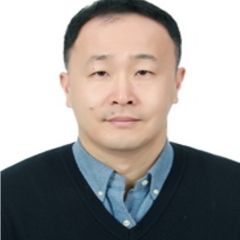
Prof./Dr. SangHyeon Kim is currently an Associate Professor in Electrical Engineering department of to Korea Advanced Institute of Science and Technology (KAIST), Korea. He received his B.S., M.S., and Ph.D. degrees in electronic engineering from The University of Tokyo, Japan, in 2009, 2011, and 2014, respectively.
After his Ph.D., he was with Korea Institute of Science and Technology (KIST) in 2014 until he moved to KAIST in 2019. Before joining KAIST, he was also a post-doc R&D specialist at imec, Belgium from 2017 to 2018.
His current research interests include Next-generation computing/communication devices, including CMOS, Quantum, Processing in memory, Cryogenic electronics, RF/Power analog devices, MicroLED, thin-film imager, and MID-IR photonics, etc., with a focus on monolithic 3D integration.
In this area, he has published more than 160 journal articles and presented more than 130 papers at flagship conferences in the semiconductor device society, such as IEDM, VLSI Symposium on Technology and Circuits. He also served as Sub-committee chair in EDTM (2023), General Vice-secretary in CSW (2023), TPC in VLSI (2025, 2026), IEDM (2022, 2023), and many other international conferences.

Prof. Yongrok Jeong’s research focuses on micro/nano-engineered transducers for extreme environments, including flexible sensing, programmable actuation, and energy conversion. The lab aims to develop resilient and adaptive systems that withstand harsh conditions while enabling real-time monitoring and functional response.
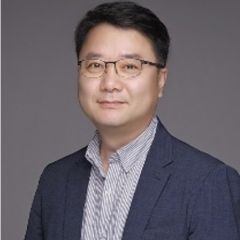
Professor Jae Yong Song is a faculty member at POSTECH, affiliated with the Department of Semiconductor Eng. and Department of Materials Science and Engineering. He received his Ph.D. in Materials Science and Engineering from KAIST and his M.S. and B.S. in Metallurgical Engineering from Seoul National University.
Prior to joining POSTECH, he served as a Principal Research Scientist at Korea Research Institute of Standards and Science (KRISS), where he held multiple leadership positions, including Director and Center Head. His research spans advanced semiconductor packaging and nanotechnology, with extensive contributions to national R&D programs and academic societies. He has held key roles in organizations such as the National Research Foundation of Korea (NRF) and the Presidential Advisory Council on Science and Technology (PACST).
His current research focuses on advanced interconnect technologies and thermal management in semiconductor devices, emphasizing interdisciplinary collaboration between academia and industry.
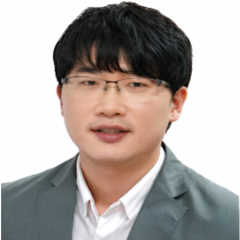
Sung-Min Lee is currently a Full Professor in the Department of Electrical Engineering at Hanyang University in South Korea. He received a B.S. degree from Seoul National University, South Korea in 2006, and M.S./Ph.D. degrees from Korea Advanced Institute of Science and Technology, South Korea in 2008/2012, respectively, all in electrical engineering.
Prior to joining Hanyang University, he was a Postdoctoral Research Associate at the University of Southern California in the United States from 2013 to 2015, a Research Staff Member at Samsung Advanced Institute of Technology in South Korea from 2015 to 2016, and an Assistant/Associate Professor at Kookmin University from 2016 to 2023. He also served as a Visiting Assistant Professor at Terasaki Institute for Biomedical Innovation in the United States in 2022.His research interests have been on emerging optoelectronic devices and systems with unusual functions and enhanced performance. He has been studying (i) free-form displays and lightings, (ii) flexible/wearable/transparent semiconductor photovoltaics, (iii) optical sensor systems, and (iv) biocompatible electronics. He has given several invited talks and lectures at conferences and seminars, and authored over 50 peer-reviewed journal articles (H-index = 24). Since 2021, he has served as an Asian Program Committee Member of the Society for Information Display (SID) and Technical Program Committee Session Chair of the Global Photovoltaic Conference (GPVC). Also, he has been working as an associate editor of the IEEE Transactions on Electron Devices since 2023.

Ton Peijnenburg is a research fellow at the High Tech Systems Center (HTSC) that performs fundamental research and design of new concepts and prototypes for high-tech equipment. His main affiliation is with VDL Enabling Technologies Group where he is Deputy Director of VDL ETG Technology & Development. At HTSC Ton Peijnenburg is concerned with the development of collaborative research programs for industrially relevant areas. In addition, the implementation of systems thinking in research- and development environments has his attention. The key question on how to train system engineers needs to be specifically addressed for the high-tech equipment domain.
Ton Peijnenburg studied Electrical Engineering at Eindhoven University of Technology (TU/e, the Netherlands) where he obtained his MSc in 1992. He then started working as a development engineer at Philips’ Center for Industrial Technology (Eindhoven). From 2002 until 2007, he was a mechatronics systems manager at Philips Electronics North America. From 2008 until 2010, he was R&D manager for the Phenom Scanning Electron Microscopes at FEI company (Eindhoven). In 2010 he became manager Advanced Developments at VDL Enabling Technologies (Eindhoven), where he currently is Deputy Manger of the Technology & Development organisation within VDL ETG. In 2015, Ton Peijnenburg was appointed research fellow at TU/e High Tech Systems Center.

Paul Blom has been working at VDL ETG for more than 13 years, and is a systems engineer in the Technology & Development organisation within VDL ETG. His background lies in plasma physics and high voltage engineering. Next to customer projects related to wafer handling and electron beam optics, he is actively involved in research projects both at the university and at VDL ETG, related to contamination control.

Rob Frijns is Vice President R&D at NXP Semiconductors. He has 35 years experience in the Semiconductor industry in management positions in Research & Development, Manufacturing and Design Platforms. In his current role as CTO Chief of Staff he is driving R&D efficiency and Program Management at NXP. Rob obtained his master degree in Applied Physics at the Eindhoven University of Technology.
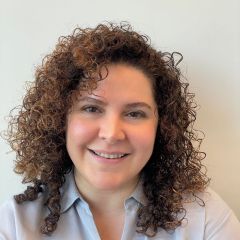
Vina Faramarzi is a technologist and researcher in ASML, her work is focused on advanced patterning solutions for emerging semiconductor device technologies. She did her PhD in the university of Strasbourg on “light-triggered molecular electronics in the 10-100 nm size range” where nanofabrication, electronics and chemistry meet to form novel semiconductor device concepts. She collaborates closely with research organizations as imec and several academic institutes across Europe
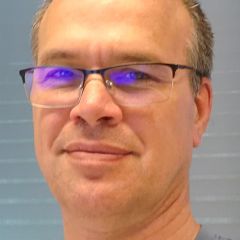
Dr. Van der Wel has been with NXP since 2005, and is currently R&D Director for the product line In-Vehicle Networking in Nijmegen. He holds 15 patents, and has authored or co-authored over 15 peer-reviewed papers. He leads a team of architects and designers developing cutting-edge automotive network transceivers in advanced CMOS and SOI processes. Dr. Van der Wel holds a Ph.D and M.Sc in Electronic Engineering from the University of Twente and is a qualified physics teacher.
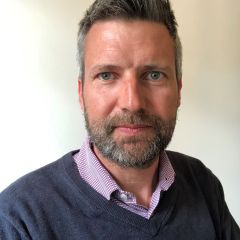
Dr. Alessio Filippi has been with NXP since 2012, and is currently Fellow in the business line Radio Frequency processing. He is part of the Innovation team and manages and contributes to the long term program on digital algorithms and advanced waveform for automotive radar. He holds 20 US patents, and has authored or co-authored over 25 peer-reviewed papers.
Dr. Filippi holds a Doctorate degree in Electronic Engineering from the University of Kaiserslautern, Germany and a Master degree in Telecommunication Engineer from the University of Padova, Italy.

Lulu Braak-Chan graduated from Eindhoven University of Technology with a Master of Science degree in Electrical Engineering. She joined NXP Semiconductors in 2014 in the Automotive department and is currently a Senior Principal Systems Architect in PL Automotive Systems & Platforms, leading the Eindhoven System Incubator team, focusing on In-Vehicle Architecture and ADAS. Next to that, Lulu serves in technical program committees of scientific conferences, representing the industry and focusing on automotive applications, time sensitive networking, in-vehicle architectures and Software-Defined Vehicles.
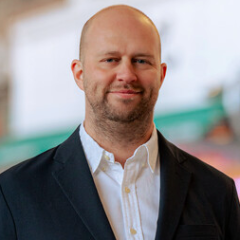
Rick van den Bosch is co-founder and CEO of GI Ventures, a Dutch-Korean venture builder based in the Brainport region around Eindhoven. While most venture builders focus on developing new technologies, GI Ventures centers on internationalization, helping Korean companies enter new markets and use the Netherlands as their European landing point. The firm supports more than 25 companies across semiconductors, deep tech, energy, enterprise software and beyond, turning early interest into pilots, partnerships and joint ventures. Rick is a serial entrepreneur with several exits, now focused on helping other founders take the right steps to grow their business.

John Smeets is Program Director part of NXP CTO Office covering Chief Technology Office program planning, Long Term Innovation and University Research programs.
30 plus years experience in Innovation program and project management covering all aspects of the funnel from scouting/research until consumer product development.
Active in consumer electronics, components and semiconductor industries. Worked with end-customers and internal customers.
Responsibilities from proof of concept until manufacturing release of new product.
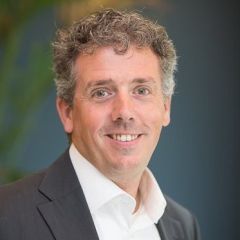
Marco van Hout, based in Eindhoven, NB, NL, is currently a Global Sales Manager at Prodrive Technologies. Marco van Hout brings experience from previous roles at Entner Electronics, cosine BV, Mecal and Orion Engineering. Marco van Hout holds a 2009 – 2011 ing. in Industrial Business Engineering – Technische Bedrijfskunde @ Fontys University of Applied Sciences.

Florian Federer is a Business Development and Ecosystem professional at PhotonDelta, where he supports the growth of the Dutch and European integrated photonics industry. Based in Eindhoven, he focuses on building international collaborations with partners and ecosystems in Asia, working closely with countries like Japan, Taiwan, Korea, Singapore and others. With a background in electrical engineering and previous experiences at Texas Instruments, Florian combines technical expertise with strategic ecosystem development, particularly in silicon photonics, co-packaged optics, and advanced semiconductor applications.

Eveline Verholt is Project Manager Talent Attraction & Engagement within the Human Capital team at PhotonDelta. She focuses on strengthening the talent pipeline for the integrated photonics industry by connecting today’s workforce with tomorrow’s needs and helping to build a strong, attractive industry brand. With seven years of experience in marketing and branding, especially in promoting the Brabant region as an international business hub, she brings a strong background in place branding and positioning. This experience supports her work in increasing awareness and appeal of careers in integrated photonics.

Luc Augustin received the M.sc. and Ph.D degree in electrical engineering from Eindhoven University of Technology. He is the CTO of SMART Photonics, where he is responsible for the technology roadmap, strategy and R&D. His expertise is in photonics, fabrication and characterisation of InP photonic integrated systems.

Johan H. Klootwijk – electrical engineer by training – has a career spaning through advanced RF technologies, MEMS, nanowire sensors, EUV lithography components, and 3D micro‑devices at Philips Research, later Philips MMD and now at XIVER. He work has been recognized through multiple awards, including the ESSDERC Best Paper Award and the NXP Invention of the Year Bronze Award, and has held key leadership roles such as Microsystems Team Lead, Overall Project Lead for major European Penta programs and currently as the Team Manager of the PD&M group. Since 2022 he has also lectured at TU/e, developing a new PIC microfabrication course, while continuing research on InP HBTs with collaborators. In 2025 he was appointed part‑time full professor.

Sya Nazary is business development expert and brings over 13 years of international leadership experience in the technology and semiconductor sectors. He spent 8 years at Intel leading the Transportation and Automotive segments with a prime focus on edge AI projects.
He also brings expertise in activating a global ecosystem in transformational projects and developing long term go-to-market strategies. Sya holds an MBA in Strategic Innovation Management from the University of Groningen.
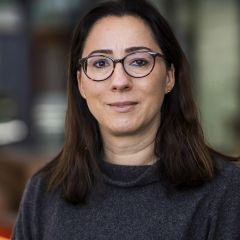
Dr. Patty Stabile is Associate Professor at TU/e within the Electro-Optical Communication system group. She moved to TU/e in 2009 for working on large-scale photonic integrated circuits, for which she was awarded the “Early Career Women in Photonics Special Recognition” from the European Optical Society. She is co-applicant and PI within several European Projects (e.g. Passion, Twilight, KDT Clever), PI within large national program (e.g. Gravitation programs Nanophotonics and Networks and PhotonDelta NGF), as well as co-applicant of the recently started NWA NL-ECO large national program, with strong focus on unconventional energy-efficient computing paradigms. She is author and co-author of more than 150 papers and chair of the IEEE Photonics Benelux Chapter. She has been visiting scientist at University of Cambridge in UK in 2010 and at MIT in 2018. She is expert in large-scale photonic integrated circuits based on semiconductor-optical-amplifiersdesign for high-capacity nodes for next generation optical networks. She is also expert in mapping neural network models on photonic hardware for neuromorphic optical computing and plan to co-design architectures which see the system co-integration of electronics and photonics.

Prof. Federico Corradi is a Professor in the Electrical Engineering Department of the Eindhoven University of Technology, leading the Neuromorphic Edge Computing Systems Lab. Prof. Corradi received a Ph.D. degree in Neuroinformatics from the University of Zurich and an international Ph.D. from the ETH Neuroscience Centre Zurich in 2015. He was a Postgraduate at the Institute of Neuroinformatics in 2018. From 2015 to 2018, he worked in the Institute of Neuroinformatics’ spin-off company, Inilabs, developing event-based cameras and neuromorphic processors. From 2018 to 2022, he contributed to several neuromorphic IC designs at IMEC, the Netherlands. His research focuses on neuromorphic computing and ultra-low-power smart sensing technologies. He is an associate editor for the Elsevier Microprocessors and Microsystems journal and he serves as a review editor for Frontiers in Neuromorphic Engineering and IEEE Integrated Circuits and VLSI, among other international journals. In addition, he is a technical program committee member for several international conferences and symposia, including ICONS, IJCNN, NEWCAS, AIAI, DSD, and TINYML

Pieter Harpe received the MSc and PhD degrees from the Eindhoven University of Technology, and then he worked for several years at imec on ultra-low-power ADCs. In 2011, he joined Eindhoven University of Technology, where he is currently an Associate Professor and lead of the Resource Efficient Electronics Lab. His main activities are on low-power analog and mixed-signal circuits. Dr. Harpe is subcommittee chair for ISSCC, TPC member for A-SSCC, Associate Editor for TCAS-I, SSCS AdCom Member-at-Large and SSCS Distinguished Lecturer.

Yuqing Jiao is Associate Professor at Eindhoven University of Technology, TU/e. His key fields of expertise include photonic integrated circuits (PICs), their manufacturing technologies and application exploitations.
He is currently leading the research activities on advanced nanophotonic PICs. He is focusing on key enabling technologies for manufacturable nanophotonics. Based on this platform, he studies ultrafast optoelectronic sciences and strong light-matter interactions in these highly confined nanostructures. He actively exploits unique application opportunities span from optical interconnects, terahertz photonics, to optical beam steering and sensing. His other research interests include novel materials for photonics, nanophotonic process design kit (PDK) and photonics/electronics co-integration.